Is Fox News reliable? Here's what analyzing their articles actually shows
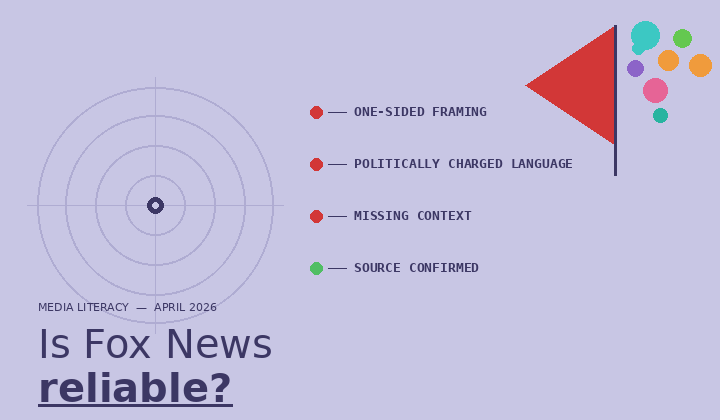
Fox News is one of the most-watched cable news networks in the world. It is also one of the most polarizing. Depending on who you ask, it is either a necessary counterweight to a left-leaning media establishment, or a partisan outlet that consistently frames the news to serve a political agenda. Both camps hold their position with conviction. Neither tends to show their reasoning.
So rather than asking whether Fox News is trustworthy as a brand, it is more useful to ask a narrower question: what do individual Fox News articles actually look like when you examine them for credibility, bias, and structural quality?
Impact News Lens analyzed 7 recent Fox News articles pulled from its Firestore cache to find out.
What the data shows
Across the 7 articles analyzed, scores ranged from 2 to 4 out of 5. Three articles scored 2, two scored 3, and two scored 4. The average credibility score was 2.9 out of 5.
The single most common flag was Emotional Language, appearing in 5 of the 7 articles. Missing Perspective appeared in 3, and One-Sided Framing appeared in 2. These are not the same as fabrication. They are structural choices that shape how a reader processes information before they have had a chance to evaluate it.
What "Low Credibility" does and does not mean
A low credibility score does not mean the article is making things up. It means the article has structural weaknesses that reduce a reader's ability to evaluate the claims being made. Those weaknesses appeared in consistent patterns across the Fox News articles analyzed.
One-sided framing. Articles frequently presented one political perspective without engaging with the strongest counterarguments. This is not unique to Fox News, as it appears across the political spectrum in cable news, but it was present in nearly every article examined.
Politically charged language. Phrases like "radical left," "deep state," or "out-of-control spending" carry ideological weight before a single fact has been presented. This kind of language is a framing choice, and framing choices accumulate across an article.
Missing context. Several articles reported on statistics or policy outcomes without the background needed to evaluate them. A claim about crime rates, for example, means very little without knowing the time period, the methodology, and what changed.
Selective sourcing. Many articles cited only sources aligned with a particular conclusion. This is different from lying. It is a form of curation that determines what picture the reader is shown.
Emotionally loaded headlines. Headlines often overstated or reframed the content of the article itself. A reader who stops at the headline, which most do, receives a different impression than one who reads to the end.
A closer look at one example
One article analyzed covered the 2026 White House Correspondents' Dinner shooting. Its headline connected the incident directly to a Senate Democrat-led funding lapse that had left Secret Service agents unpaid for 60 days. The connection was stated as causal: the funding gap put agents "in the line of fire."
Impact News Lens flagged this article with three red flags: One-Sided Framing, Political Context Not Explained, and Missing Perspective. The credibility score was 3 out of 5.
The core facts were not disputed. A shooting happened; agents were unpaid due to a funding lapse; Democrats had blocked a spending bill. But the article presented only one party's framing of the budget dispute without including any response from the other side, and it implied a direct link between unpaid agents and the shooting without establishing one. That is what structural bias looks like in practice: not fabrication, but framing that leads the reader to a conclusion the evidence does not fully support.
What higher-scoring articles looked like
Not every Fox News article scored low. Two of the seven analyzed scored a 4 out of 5.
One covered a DOJ indictment of two Chinese nationals who ran a cryptocurrency scam center using human trafficking to target Americans. The reporting was factual, sourced to the Department of Justice, and the claims matched the official charges. Its two flags were emotional language ("economic homicide," "enslaved") and the absence of a statement from the defendants, both common limitations in breaking legal news rather than signs of editorial distortion.
The other was an opinion piece arguing that a media narrative surrounding the 2017 Charlottesville rally was a hoax, based on a new DOJ indictment of the SPLC. It scored 4 out of 5 because the factual claims were grounded in an actual indictment. The flags reflected its nature as opinion: loaded language, no SPLC response, and a conclusion that the narrative was definitively a hoax, one that outran what an indictment alone can prove.
The pattern that emerges is consistent. Fox News's factual and legal reporting tends to hold up. The structural problems cluster around political framing, missing opposing voices, and editorial choices that lead the reader toward a conclusion before the evidence has been fully laid out.
Does this make Fox News unreliable?
That depends on what you mean by reliable.
Fox News breaks real news. It has correspondents on the ground. It covers stories that other outlets underreport or ignore entirely. Its audience is large, politically diverse within its lane, and genuinely interested in the news. None of that disappears because the framing choices in individual articles lean in a predictable direction.
What the data suggests is that Fox News, like most cable news outlets, has a consistent editorial lean, in this case toward conservative and Republican-aligned perspectives. That lean shapes which stories get covered, how they are framed, and what context is included or omitted.
Knowing that a source has a lean is useful information. It tells you where to look harder, which questions to ask, and which perspectives you might need to seek out elsewhere. It is not a reason to stop reading. It is a reason to read differently.
The habit that actually helps
The question "is Fox News reliable?" is ultimately the wrong question to carry into your news reading. It treats reliability as a fixed property of a brand, something you look up once and apply forever.
It is not. Reliability is a property of individual articles, and it varies. The same outlet that publishes a misleading headline on Tuesday can publish accurate, well-sourced reporting on Wednesday. Brand-level trust is a shortcut. It is not an analysis.
Three questions that help more than brand-level judgments:
Does the headline match the body? Read past the first two paragraphs before deciding what the article is actually claiming.
Who is missing from this story? One-sided articles are usually not wrong about what they include. They are incomplete about what they leave out. Ask whose perspective would change the picture.
Is the emotional tone doing work the facts are not? Language that provokes a reaction before you have processed the evidence is worth flagging, regardless of which direction it leans.
What a source like Fox News actually tells you
A media outlet's general lean is real information. Knowing that Fox News tends toward conservative framing, that it covers the Biden and Harris years through a critical lens, and that its political analysis often reflects a particular worldview: all of that is useful context.
But context is not verdict. Lean tells you where to look harder, not what to conclude. An article from a right-leaning outlet can still be accurate. An article from a supposedly neutral outlet can still mislead. The only analysis that actually tells you whether a specific article is worth trusting is the analysis of that specific article.
See what any article is leaving out. Impact News Lens analyses bias, missing context, and framing in seconds. Free — works on Chrome, Edge, and Brave.