Is CNN reliable? Here's what analyzing their articles actually shows
CNN is one of the most-watched news networks in the world. It is also one of the most contested. Depending on who you ask, it is either a reliable pillar of global journalism or a left-leaning outlet that frames the news to fit a narrative. Both camps tend to hold their view with confidence. Neither tends to show their work.
So rather than asking whether CNN is trustworthy as a brand, it is more useful to ask a narrower question: what do individual CNN articles actually look like when you examine them for credibility, bias, and structural quality?
Impact News Lens analyzed a set of recent CNN articles from early 2026 to find out.
What the data shows
Across the articles analyzed, the results were striking. Ten out of eleven scored "Low Credibility," with credibility scores of 1 or 2 out of 5. Only one article received a "High Credibility" rating, scoring a 5. That article was a guest essay on child labor and forced labor practices, written by a named author with a clear evidence base.
The pattern is worth sitting with. A single outlet. Recent articles. And an overwhelming majority flagged for structural problems.
But before drawing conclusions, it matters to understand what those flags actually mean.
What "Low Credibility" does and does not mean
A low credibility score does not mean the article is fabricating facts. It means the article has structural weaknesses that make it harder to evaluate what is actually true. Those weaknesses appeared in consistent patterns across the CNN articles analyzed.
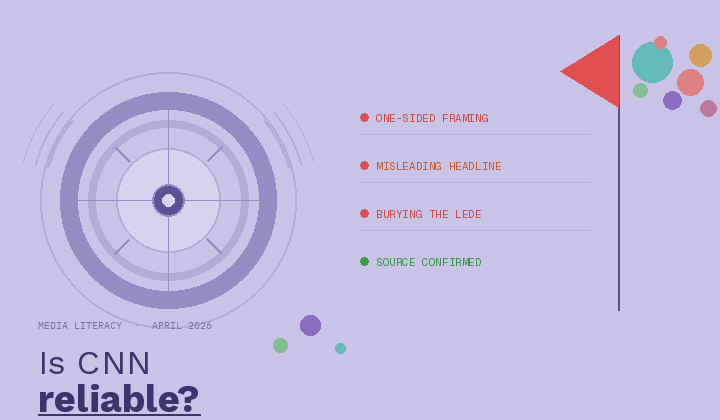
Burying the lede. Several articles placed the most important context deep in the piece, sometimes after six or seven paragraphs of framing. By then, most readers have already formed an impression.
Misleading headlines. The headline and the article body often told different stories. A headline about a Chinese robot running faster than any human turned out to be based on a misleading comparison: the robot ran on a purpose-built track under controlled conditions, not in a race against humans. The headline was technically defensible. It was also designed to produce a false impression.
Emotionally loaded language. Phrases like "Trump's latest broadside" or "historic oil crisis" carry emotional weight that shapes how a reader processes the facts before they have read any of them. This is not necessarily dishonest. It is a framing choice, and framing choices accumulate.
Framing by juxtaposition. Multiple articles placed unrelated facts next to each other in ways that implied a connection without stating one. This is one of the harder red flags to spot because it does not require any false claims. The implication does the work.
Speculative language. Several pieces used phrases like "costs are starting to grow" or "may be too late" to describe situations that were still unfolding. Speculation presented in the tone of analysis creates a false sense of certainty.
A closer look at one example
Take the article published on April 19, 2026: "A Chinese android just ran a half-marathon faster than any human ever."
The headline is designed to provoke a reaction. It implies a technological milestone, a moment where machines have overtaken human physical capability. The actual story is narrower: a robot completed a half-marathon course, but under conditions that make a direct comparison to human performance misleading.
Impact News Lens flagged this article with three red flags: Misleading Comparison, Sensationalist Headline, and Geopolitical Framing. The geopolitical framing is subtle but present throughout. The article consistently positions the achievement within a US-China technology rivalry, adding a layer of narrative that the facts alone do not require.
This is not unique to CNN. It is a pattern that appears across outlets when covering stories about China, AI, and technology competition. The framing precedes the evidence.
What the one high-credibility article looked like
The guest essay on child labor scored a 5. It was also flagged for red flags, specifically Appeal to Emotion, Argument by Redefinition, and Lack of Verifiable Data. That combination is instructive.
A high credibility score does not mean an article is flawless. It means the article's overall structure is sound: the claims are grounded, the author is identified, the evidence is traceable, and the argument is made explicitly rather than through implication. The emotional appeal in that piece was in service of a coherent argument, not a substitute for one.
That distinction matters. Good journalism can move you. The question is whether the emotional weight is carried by the evidence or by the writing.
Does this make CNN unreliable?
That depends on what you mean by reliable.
CNN breaks real news. Its correspondents are on the ground in conflict zones and political events that matter. It publishes analysis from named experts and covers stories that do not get airtime elsewhere. None of that disappears because the framing choices in individual articles are sometimes questionable.
What the data suggests is that CNN, like most major outlets, has a consistent editorial lean. The analysis showed a "One-Sided" bias label on the majority of articles examined. One-sided does not mean wrong. It means the strongest counterarguments are often absent, and the framing tends to point in a particular direction.
That is a useful thing to know going into an article. It is not a reason to stop reading CNN. It is a reason to read it with the same critical attention you would apply to any outlet.
The habit that actually helps
The question "is CNN reliable?" is ultimately the wrong question to carry into your news reading. It suggests that reliability is a fixed property of a brand, something you look up once and apply forever.
It is not. Reliability is a property of individual articles, and it varies. The same outlet that publishes a misleading headline on Tuesday can publish rigorous reporting on Wednesday. The guest essay and the robot half-marathon story appeared within days of each other on the same site.
Three questions that help more than brand-level trust judgments:
Does the headline match the body? Read past the first two paragraphs before deciding what the article is actually claiming.
Who is missing from this story? Most one-sided articles are not wrong about what they include. They are incomplete about what they leave out. Ask whose perspective would change the picture.
Is the emotional tone doing work the facts are not? Language like "sparking celebrations" or "latest broadside" carries a signal. It is worth asking whether that signal is earned by the evidence or imported by the writer.
What a source like CNN actually tells you
A media outlet's general lean is real information. Knowing that CNN tends toward center-left framing, that it covers the Trump administration through a critical lens, and that its international reporting often reflects a particular geopolitical worldview: all of that is useful context.
But context is not verdict. Lean tells you where to look harder, not what to conclude. An article from a biased outlet can still be accurate. An article from a supposedly neutral outlet can still mislead.
The only analysis that actually tells you whether a specific article is worth trusting is the analysis of that specific article.
See what any article is leaving out. Impact News Lens analyses bias, missing context, and framing in seconds. Free — works on Chrome, Edge, and Brave.