Inside media bias databases - lessons from Media Bias Fact Check
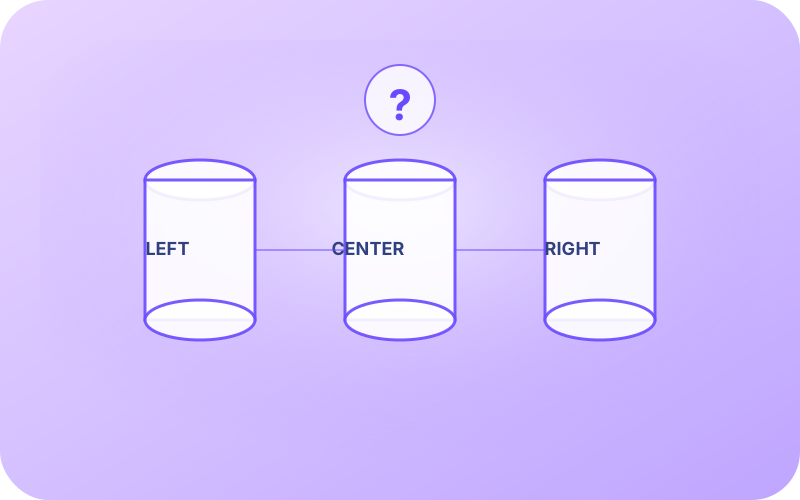
Media bias databases promise clarity. They turn a chaotic media landscape into something readable by reducing complex reporting to simple labels like left, right, or center. That promise feels reassuring, especially in an environment where news is constant and attention is limited. It is also incomplete.
Why media bias databases exist
Modern news is exhausting. The volume is high, the speed is relentless, and context is often thin. Readers look for shortcuts that help them decide what to trust and what to ignore. Bias databases step into that gap by offering structure and apparent consistency.
The underlying assumption is straightforward: bias is stable, can be categorised, and repeats itself over time. Sometimes that assumption holds. Often it does not.
How Media Bias Fact Check works
Media Bias Fact Check evaluates news outlets rather than individual articles. Its ratings are based on long-term patterns such as historical accuracy, fact-check records, sourcing behaviour, political alignment, and corrections over time.
The result is a static outlet profile: a reputation score that changes slowly. This makes the database usable and predictable. It also makes it blunt.
Where this approach helps
For media literacy, bias databases are genuinely useful. They encourage readers to question sources instead of taking them at face value. They also reduce cognitive load by offering quick orientation in a crowded media landscape.
As a starting point, this approach works well. As a final judgement, it falls short.
The structural problem with outlet-level bias
News is produced article by article. Bias emerges at the level of individual stories, not at the level of an abstract outlet identity.
A single outlet can publish careful, data-driven reporting in the morning, emotionally framed coverage in the afternoon, and selectively sourced analysis the next day. The outlet label remains unchanged, while the framing shifts continuously.
A simple case
An internationally respected outlet is rated center left, a label that has remained stable for years. The same outlet publishes an article on migration. The tone is emotional, statistics are largely absent, and one perspective dominates the narrative.
The label suggests balance. The article does not.
The reader trusts the database. The framing passes unnoticed.
What Media Bias Fact Check does well
The strength of Media Bias Fact Check lies in transparency and consistency. Its methodology is public, its criteria are clearly explained, and labels are not changed lightly. For education and reference, this stability matters.
What it cannot see
Bias is not only ideological. It is structural.
It appears in what is omitted, who is quoted, how scale is framed, and which emotions are amplified. These signals live inside individual articles, not inside outlet profiles stored in a database.
Why static labels are risky
Static labels turn bias into identity. They suggest permanence and discourage close reading. Trust quietly shifts from the text itself to the reputation attached to it. That shift is a mistake.
Why article-level analysis matters
Readers interact with articles, not with databases. Understanding framing requires analysing structure, emphasis, and omission within the text itself, not checking a label attached to the publisher.
This does not require neutrality. It requires visibility.
How Impact News Lens approaches this differently
Impact News Lens does not assign ideological scores or permanent labels. It analyses the article itself: what is present, what is missing, and where emphasis is placed.
The goal is not to declare truth. The goal is to expose structure and let readers draw their own conclusions.
Closing thought
Media bias is situational, not permanent. Databases are maps. Articles are terrain.
Use the map. Read the terrain.