5 Ways to Check If an Article Is Credible Before You Share It
Every day, millions of people share articles they have not really read. And millions more read articles they have not really questioned. The result is a news environment where false and misleading content spreads faster than corrections ever can.
The good news: you do not need a journalism degree to evaluate whether an article is worth trusting. A few consistent habits, applied before you read past the headline, will catch most of the problems most of the time.
Here are five checks that actually work.
1. Look at who wrote it and who published it
The byline and the outlet are not proof of accuracy. But they are a fast first filter.
For the author: search their name. Do they have a track record of reporting on this topic? Is their background relevant? An anonymous article or one with no verifiable author is a yellow flag, not an automatic disqualifier, but worth noting.
For the outlet: is it one you recognise, and do you know its editorial standards? Outlets like Reuters, the Associated Press, or the BBC have public editorial guidelines and corrections policies. A website you have never heard of, with no About page and no named editorial staff, deserves much more scrutiny.
One thing to watch for: outlets that look legitimate but are actually partisan operations. They use professional-looking designs and neutral-sounding names. The difference usually shows up in the sourcing and framing, not the appearance.
2. Check the date
This sounds obvious. It is not.
Old articles regularly resurface in new contexts. A story from 2019 gets shared in 2026 as though it just happened. The underlying facts may still be technically accurate, but the framing is now misleading because the situation has changed.
Before reacting to or sharing anything, check when it was published. If the story is old, ask whether it is still relevant in its current form.
3. Find the primary source
Good journalism points to its sources. A strong article will tell you which study it is citing, which official said something, which document a claim is drawn from.
When those sources are named, go find them. Read the actual study, not just the article's description of it. Watch for this pattern: an article says "a new study shows X" but the study, when you read it, says something more qualified, more limited, or even slightly different. The distortion is rarely deliberate. It is often just compression. But the effect is the same.
If an article makes a strong claim and cites no source at all, that is a significant credibility problem.
4. Look for what is missing
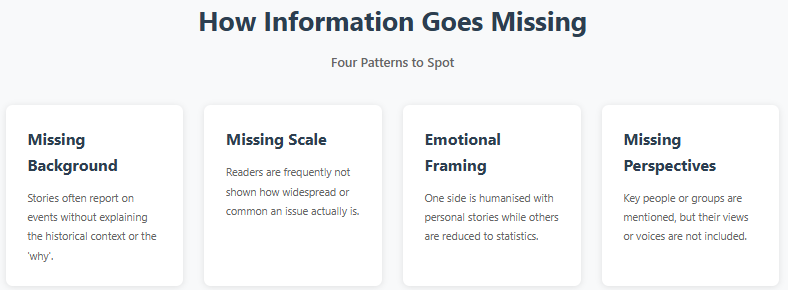
Credible journalism presents the strongest available version of the opposing view. If an article about a political decision never mentions the main objections to it, that is not objectivity. That is framing.
Ask yourself: what would someone who disagrees with this article say? Is that perspective anywhere in the piece? If not, what you are reading may be accurate on its own terms but incomplete in a way that changes the overall impression.
This is what Impact News Lens flags as "one-sided." The article is not necessarily lying. It is just not giving you the full picture.
5. Check whether the headline matches the article
Headlines are written to get clicks. The article body is written to be accurate. These two goals do not always produce the same output.
Read the headline, then read the article. Does the story actually support what the headline claims? A headline that says "Study proves X" and an article that says "researchers found preliminary evidence suggesting X may be possible under certain conditions" are not the same thing. But they will both be read, shared, and remembered as "study proves X."
The gap between headline and content is one of the most common sources of misinformation, and it happens in reputable outlets, not just suspicious ones.
How Impact News Lens fits in
These five checks take time. Not a lot, but more than most people have when they are moving through a news feed.
Impact News Lens does a version of this automatically. When you are reading an article and want a fast structural assessment, the tool checks for missing context, one-sided framing, unsupported claims, and missing perspectives. It does not tell you the article is wrong. It tells you where to look harder.
The five manual checks above and the automated analysis work well together. The tool gives you a fast signal. The habits give you the depth to act on it.
The underlying principle
Credibility is not a property of outlets or authors. It is a property of individual claims, supported by specific evidence. A trusted outlet can publish a weak article. An unfamiliar one can publish solid reporting.
The question to bring to any article is not "is this source trustworthy?" It is: does this specific article show its work?
If it does, you are in a position to agree or disagree based on something real. If it does not, you are being asked to take someone's word for it.
See what any article is leaving out. Impact News Lens analyses bias, missing context, and framing in seconds. Free — works on Chrome, Edge, and Brave.